
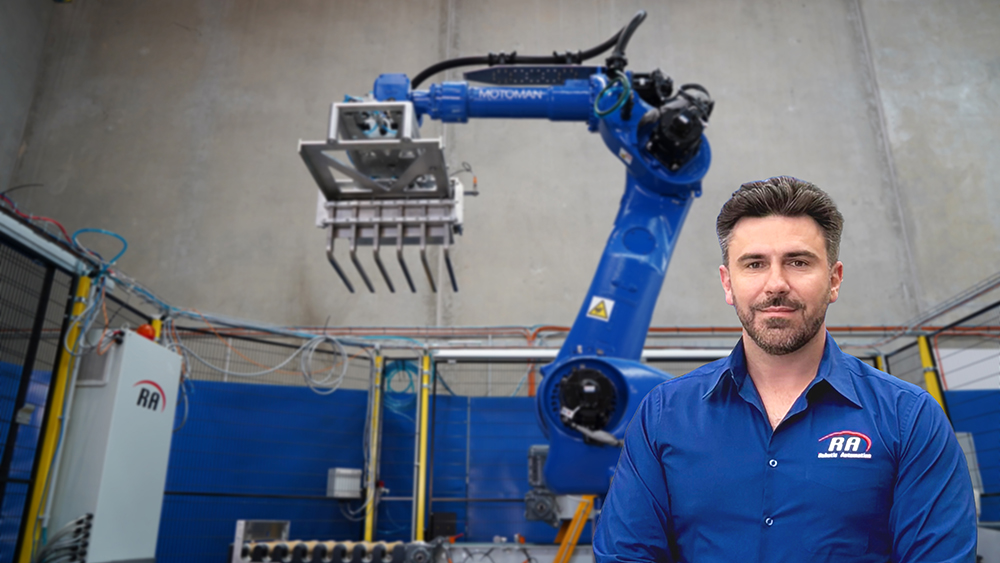
Industrial robot service: What Australian factories should expect in 2026
With automation expanding across Australian manufacturing, expectations placed on robot service teams are changing fast. In 2026, service will be defined not just by fixing faults but by predicting and preventing them before downtime occurs.
Industrial robot service is entering a new era in Australia. Connectivity, analytics and predictive tools are transforming how manufacturers maintain their robots – and in 2026, these capabilities will be the standard, not the exception.
As factories automate more of their production, expectations around robot service are shifting dramatically. Unplanned downtime is becoming far less acceptable, remote support is becoming the default, and maintenance practices are moving from “react and repair” to “predict and prevent.” Industrial robot service in 2026 will be characterised by faster diagnostics, smarter parts strategies and data-driven insights that help manufacturers protect uptime and keep automation running at peak performance.
“Australian factories are running leaner than ever, and that makes every minute of uptime count,” says Vedran Martinovic, National Service Manager at Robotic Automation™. “The shift to proactive, data-led servicing isn’t a trend – it’s becoming a requirement for competitive manufacturing.”
Typical failure modes in industrial robotics
Industrial robots are highly reliable, and most issues that do occur are simple, predictable, and easy to manage with routine maintenance. Understanding these common wear points helps factories plan servicing more efficiently.
Mechanical failure modes
- Seals and gaskets gradually wear, especially in dusty or washdown areas.
- Bearings experience natural fatigue over long operating hours.
- Gear reducers and servo motors show regular wear in high-duty applications.
- Gripper/EOAT (end-of-arm tooling) components, like valves suction cups and sensors require periodic replacement, similar to any production equipment.
Electrical and control system failures
- Controller modules may occasionally need refresh or calibration.
- Cables and harnesses experience normal fatigue over time, particularly in high-movement applications.
- Drives and power supplies may show age-related performance changes after long service life.
Human-driven failure modes
- Minor collisions during manual programming.
- Incorrect payload data affects cycle loads.
- Irregular maintenance intervals.
“From what we see on the ground, most unplanned downtime still comes from simple things – cables, connectors, gripper (EOAT) wear and human error. These are the areas factories can control with better maintenance discipline,” Martinovic says. “For 2026, expect fewer catastrophic mechanical failures thanks to better sensor feedback, trip-level alarms, and integrator-driven health monitoring.”
Critical spare parts Australian factories should hold on-site
To keep production running smoothly, having a small set of commonly replaced items on hand is good practice. These are not signs of risk – they simply reflect normal long-term usage.
High-priority spare parts
- Cables and harnesses that experience regular motion
- Controller modules or cards that assist with quick swap-and-go recovery
- Teach pendants, which are heavily used day-to-day
- Motors or reducers for the most active robot axes
- Gripper (EOAT) consumables such as cups and sensors
Standard stocking strategy
- Critical spares: Items that can stop production → always hold on-site
- Operational spares: Components with long lead times → keep 1–2 units
- Supplier-held spares: Leverage integrator-supported parts pools
2026 shift: More factories will adopt “service kitting” – preassembled spare parts packs designed around the specific robot model and duty cycle.
Remote diagnostics become the default in 2026
Remote diagnostics is now standard among most Tier-1 robot brands –Motoman Yaskawa, ABB, Fanuc, KUKA – and, by 2026, it will be central to how service is delivered in Australia.
What remote diagnostics can detect
- Overload errors and torque spikes
- Motor temperature deviations
- Abnormal vibration patterns
- Controller errors or software faults
- Safety system interruptions
Why it matters
- Technicians can triage faults before arriving on-site
- Minor issues are resolved remotely, reducing service callouts
- Faster recovery times during unplanned downtime
- Better long-term support due to logged performance data
- Cyber-secure VPN access allows safe, encrypted robot connectivity
“Remote support is now solving a huge percentage of faults without a site visit,” Martinovic says. “It shortens downtime, cuts service costs and keeps production moving when technical expertise isn’t immediately available”
2026 shift: Australian factories increasingly demand service-level agreements (SLAs) that include guaranteed remote response times.
Predictive maintenance: Emerging trends for 2026
Predictive maintenance will be one of the most transformative trends in robotic automation over the next 12–18 months.
Key emerging capabilities
- AI-driven anomaly detection using motor torque, thermal data, and cycle histories
- Health scoring dashboards built into robot controllers
- Sensorised Grippers (EOAT) that detect vacuum loss, mispicks, gripper misalignment
- Cloud-integrated maintenance logs connected to Manufacturing Execution Systems and Supervisory Control and Data Acquisition.
- Remaining-useful-life (RUL) projections for motors and reducers
What this means for operations
- Spare parts budgets become predictable
- Maintenance becomes scheduled, not reactive
- Failures are caught before they stop production
- Factories can optimise robot utilisation and cycle time
- Uptime becomes a measurable KPI tied to service contracts
2026 shift: Predictive maintenance becomes practical and affordable. Instead of costly OEM systems, integrators provide early-warning insights using the robot’s own performance data.
What Australian factories should expect overall in 2026
As automation becomes core to Australian manufacturing, service expectations are rising across the industry.
Key Takeaways
- Service will be proactive, not reactive
- Technicians evolve into data-focused robot specialists
- Remote diagnostics will be built into most support contracts
- Predictive insights will guide maintenance and parts planning
- Uptime expectations rise as automation becomes mission-critical
“The factories that act now – investing in remote access, smarter maintenance and the right spares – will be the ones with the highest throughput and the lowest lifetime robot costs. It’s not just an upgrade; it’s a competitive shift,” says Martinovic.
We’ll examine your fleet, review maintenance practices and spare parts coverage, and outline a customised service contract that keeps your automation running reliably and predictably.