
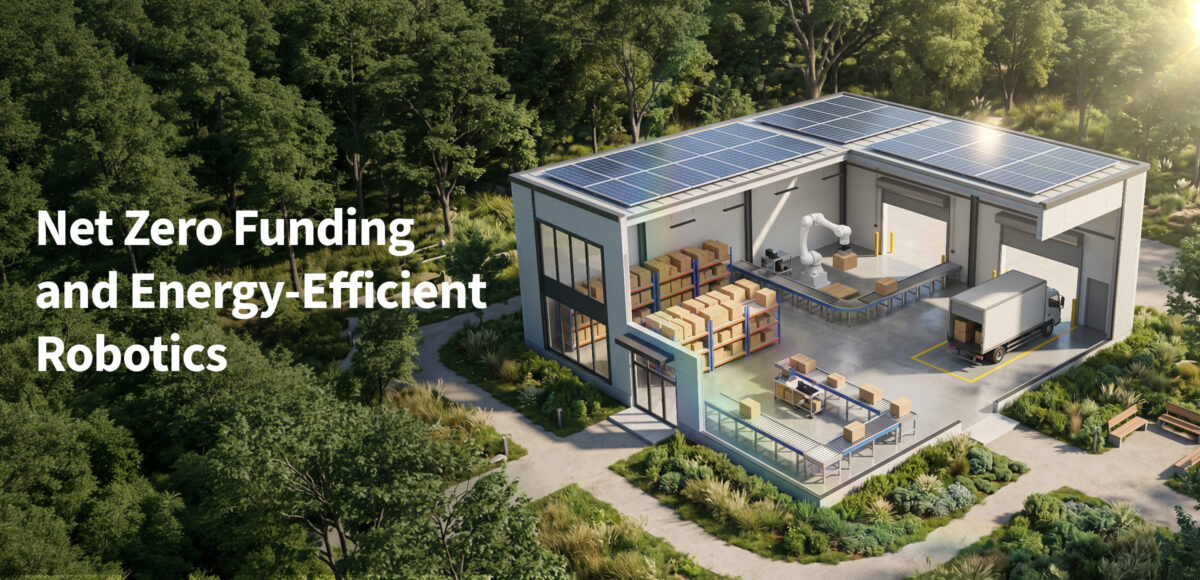
Net Zero Funding and Energy-Efficient Robotics
Every robot wastes energy. But we rarely see it.
Across most manufacturing sites, a constant stream of energy is lost during normal operation. Every time a robot slows or stops, kinetic energy is burned off as heat. It is continuous, repeatable, and rarely accounted for. Until now.
At the same time, funding is being directed toward projects that reduce energy use in measurable ways. The gap is not ambition. It is identifying where real, repeatable savings can be captured without disrupting production.
Energy-efficient robotics, including systems with energy recovery capability, are emerging as one of those investments. They shift automation from a productivity tool into something more strategic: a measurable contributor to energy reduction and funding-aligned outcomes.
Table of Contents
- What Net Zero funding means for manufacturers
- Where industrial energy is being lost
- What energy recovery in robotics actually does
- Why energy-efficient automation supports funding cases
- Practical applications in Australian industry
- How to approach a funding-ready automation project
- FAQ
What Net Zero funding means for manufacturers
The Australian Government has committed more than $5 billion toward industrial decarbonisation through large-scale funding programs. These initiatives are designed to support projects that deliver measurable reductions in emissions, particularly in energy-intensive sectors such as manufacturing, logistics, and processing.
For manufacturers, this creates a clear requirement:
- Demonstrate energy reduction
- Quantify operational improvements
- Link investment to emissions outcomes
Funding does not follow intent. It follows proof. Projects that demonstrate a clear reduction in energy use are far more likely to meet criteria and move through approval.
Where industrial energy is being lost
Much of this loss sits in motion. Motors, control systems, and high-cycle processes all contribute, but the impact is most visible where movement is constant.
In robotic applications, one of the most consistent sources of wasted energy is braking. When a robot arm decelerates, kinetic energy is typically dissipated as heat through resistors. This happens continuously in operations such as:
Across thousands of cycles, this represents a constant loss of recoverable energy.
What energy recovery in robotics actually does
Energy recovery systems change how robotic motion is managed.
Instead of dissipating braking energy as heat, the system captures that energy and converts it into usable electrical power. In the case of Yaskawa MOTOMAN systems, this energy can be fed back into the facility’s power supply as standard 400VAC, 50Hz power.
This has two implications:
- Energy is reused rather than lost
- Total facility energy demand is reduced
The impact is cumulative. In high-duty-cycle environments, even small recovery gains per cycle can translate into meaningful reductions in overall consumption.
To make this visible at a system level, platforms such as Yaskawa Cockpit provide real-time insight into robot performance, including energy consumption and regeneration data. This allows operators to track where energy is being used, where it is being recovered, and how those gains translate across the broader facility.
Why energy-efficient automation supports funding cases
Net Zero funding programs are not focused on technology labels. The key requirement is evidence of reduced energy use and emissions.
Energy recovery robotics supports this in three ways:
Measurable energy reduction
Recovered energy reduces net power draw. This can be modelled and quantified before implementation.
Clear link to emissions outcomes
Lower energy consumption translates directly into lower emissions, particularly in grid-dependent facilities.
Stronger business case
Energy savings contribute to operating cost reduction, improving ROI alongside any funding support.
This combination makes automation projects easier to justify both internally and externally. Instead of being seen as a capital expense, they can be positioned as part of a broader decarbonisation strategy.
Practical applications in Australian industry
Energy recovery capability is most relevant in environments with frequent acceleration and deceleration cycles.
Robotic welding
High repetition and continuous motion create consistent opportunities for energy capture, while also improving process stability.
Palletising and packaging
End-of-line systems often run at high throughput, making cumulative energy recovery more significant over time.
Material handling and logistics
Applications involving frequent starts and stops benefit from reduced wasted energy and improved system efficiency.
The gains do not stop at the cell. Recovered energy feeds back into the facility, lowering total demand.
How to approach a funding-ready automation project
Manufacturers looking to align automation with Net Zero funding should take a structured approach:
Assess current energy use
Identify high-energy processes and repetitive motion systems.
Target high-cycle applications
Focus on areas where energy recovery will have the greatest cumulative impact.
Quality potential savings
Model energy reduction, cost savings, and emissions impact.
Align with funding criteria
Ensure the project clearly demonstrates measurable decarbonisation outcomes.
Partner with an automation provider
Work with a supplier that can support technical design and business case development.
Conclusion
Net Zero funding is creating a clear opportunity for manufacturers to invest in energy-efficient infrastructure. The challenge is identifying solutions that deliver both operational and environmental outcomes.
Energy recovery robotics provides a direct path to achieving both. By reducing wasted energy and lowering overall consumption, these systems support a stronger business case while aligning with decarbonisation objectives.
For manufacturers planning their next automation investment, the question is shifting. It is no longer just about productivity. It is about whether that investment can also contribute to measurable energy reduction.
To explore how energy-efficient robotics can support your operations and align with Net Zero funding opportunities, contact Robotic Automation to discuss your application.
FAQ
What types of projects qualify for Net Zero funding?
Projects that demonstrate measurable reductions in energy use or emissions, particularly in industrial environments, are typically prioritised.
How much energy can robots save?
Savings depend on application type, duty cycle, and system design. High-cycle operations offer the greatest potential for cumulative energy recovery.
Are energy recovery robots more complex to implement?
They are integrated into modern robotic systems and can be deployed as part of standard automation solutions, with additional benefits in efficiency and energy management.