Palletising Automation: Is Your Production Line Ready for Growth?
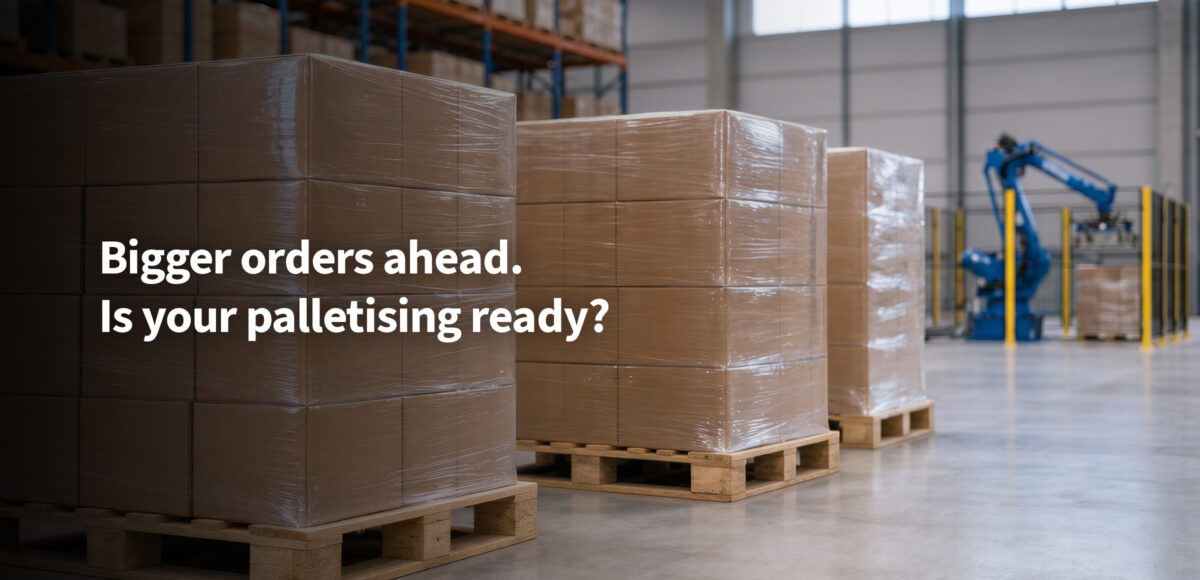
A new contract, a larger customer order or an increase in production targets can create opportunities for growth, but only if the operation can support the extra volume. The constraint may sit at the end of the line, where cartons must be stacked, pallets managed and products prepared for dispatch.
What works at today’s production rates may not be enough tomorrow. Before committing to higher output, assess whether the existing palletising operation has the capacity, flexibility and reliability to support future demand.
Assess throughput requirements
Daily production totals tell only part of the story. Cartons may arrive steadily during one run and in faster bursts during another. A system assessed against the daily average could struggle during the periods that matter most.
Look at peak production rates and how long they last. Include the output required to meet planned growth, so the assessment reflects the work the business intends to win.
Product variation matters just as much. Carton dimensions and weights influence robot and gripper selection, while packaging construction affects how products can be handled. A closed box and a shelf-ready tray may need different gripping approaches, even at a similar weight.
To assess those requirements, document:
- Carton dimensions, weights and packaging formats across the product range.
- Pallet patterns, stack heights and customer-specific requirements.
- How often products change and how changeovers fit into the production schedule.
These details help Robotics Automation Group assess whether the proposed arrangement can sustain output across the product range.
Assess space requirements
Available floor space is often an early concern. The assessment needs to account for everything moving through that space, including the supply of empty pallets and the removal of completed loads.
If finished pallets already wait for collection, faster stacking alone will leave that delay unresolved. Map the route from carton infeed through to wrapping and dispatch, noting where loads accumulate or movements compete for access.
Robotic Automation’s palletising solutions include standard cells and custom configurations. Assessing the layout helps establish which arrangement could fit and what surrounding equipment or processes would need to change.
Its Arnott’s palletising project illustrates why these details matter. The system had to handle varied shelf-ready cartons within a restricted mezzanine area. Product handling and the building’s constraints shaped the design together.
For a manufacturer planning higher volumes, installation access and commissioning also need to be considered early. A proposed system must have a realistic delivery and integration schedule before its capacity can be included in a customer commitment.
Build a business case
A recurring supply agreement gives the investment case a different foundation from a short-lived production spike. Consider how much work the system would handle over time, including quieter periods and the possibility that expected demand changes.
Test the expected benefits against the operation:
- Redeploying people: What work would they return to, and what capacity would that release?
- Reducing overtime: Do actual roster and production figures support the expected saving?
- Increasing output: Can the business sell and deliver the additional volume?
- Allowing for uncertainty: Does the investment still make sense if demand is lower than expected?
The cost assessment should cover the complete installation, including conveyors, pallet handling and integration. Robotic Automation’s palletising robot cost guide explains the main factors and provides a basis for comparing proposals.
A useful proposal should make clear which production requirements it addresses, the assumptions behind the expected benefits and what the business must provide to achieve them.
Plan for training and maintenance
The production schedule depends on operators being able to run the system and manage product changes across shifts. Training needs to cover the people who will use it day to day, including how to recognise issues and when to call for support.
Ongoing maintenance also needs a place in the operating plan and budget. Robotic Automation offers operator training and preventative maintenance support through its service agreements, with servicing handled by qualified technicians.
Establishing those arrangements early helps the business understand how the system will be supported once higher output becomes routine.
Know when to start the assessment
Recurring pressure at palletising, a defined increase in demand and a clear operational benefit are good reasons to investigate automation. They provide a basis for an assessment; approval to invest comes once suitability, cost and timing have been established.
Where demand is uncertain or completed pallets are already held up downstream, those issues need to be examined as part of the project. Identifying them early helps define what a worthwhile solution would need to achieve.
Whether you’re evaluating your first robotic palletising project or increasing volumes across an existing operation, understanding the demands of the line is the first step. A properly specified palletising system can improve throughput, reduce manual handling and support growth when it is matched to the business’s operational requirements. That gives the business a firmer basis for committing to the extra volume, through to the last pallet ready for dispatch.
Planning higher production volumes? Talk to Robotic Automation about your palletising requirements. Start with what you know about your line; the team can help identify what needs further assessment.