
What AMW 2026 Revealed About Real Automation Opportunities
AMW 2026 (Australian Manufacturing Week) in Brisbane delivered a strong signal for the industry, automation is firmly on the agenda.
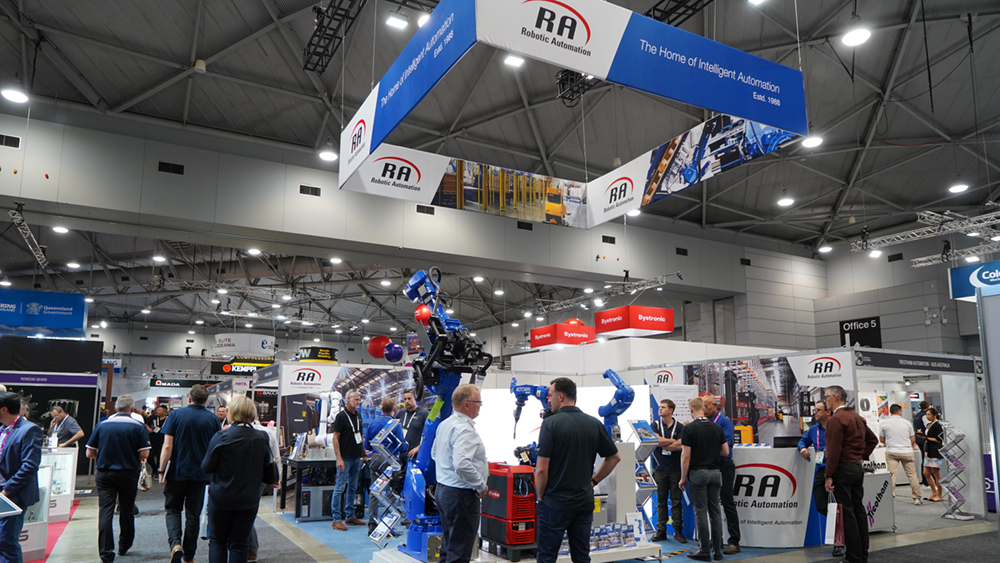
For Robotic Automation™, the show was a success. We engaged with a wide range of manufacturers across multiple sectors, many actively exploring how automation could improve their operations. The conversations were practical and grounded, focusing on applications, pricing, and how these systems could be implemented within existing environments.
As expected, robotic welding solutions attracted significant attention. Welding remains one of the most labour-intensive and technically demanding processes in manufacturing, and businesses are looking for ways to improve consistency, throughput, and safety.
Our mobile robot range also generated strong interest. Solutions using AGVs and AMRs to move materials across factory and warehouse environments are becoming increasingly relevant as manufacturers look to improve internal logistics and reduce manual handling.
But the most important takeaway from AMW wasn’t about any one technology.
It was about how automation is being approached.
Looking Beyond the Core Process
Many of the discussions at the show were centred on automating the primary task, whether that be welding, machining, or fabrication.
That’s a logical starting point. These are core processes that directly influence output and quality.
However, one of the biggest opportunities in most factories lies not in the primary process itself, but in everything around it.
The reality is that a large portion of inefficiency in manufacturing comes from material handling, movement, and end-of-line processes – not just the core task.
High-Impact, Often Overlooked Automation Areas
- Machine tending – automated loading and unloading of production equipment
- Packing – consistent and efficient preparation of products for dispatch
- Palletising – removing manual bottlenecks at end-of-line operations
- Automatic stretch wrapping – improving load security and repeatability
- Warehouse movement – loading and transporting goods via AGVs and AMRs
The Importance of System Thinking
A robotic welding cell may improve one part of the process, but if parts aren’t fed in efficiently, or finished products aren’t moved out effectively, the overall result is still constrained.
Automation works best when viewed as a connected system, not a series of isolated upgrades.
By addressing adjacent processes such as machine tending, packing, and palletising, manufacturers can achieve immediate improvements in flow, reduce manual handling, and increase overall efficiency – often with relatively straightforward implementations.
From Individual Tasks to Integrated Operations
What stood out at AMW 2026 was the growing recognition that automation is not just about solving one problem.
It’s about understanding how different parts of the operation interact and identifying where simple automation steps can increase the efficiency of the process.
In many cases, we have found some of the fastest gains don’t come from the most complex systems, but from removing everyday inefficiencies that exist between processes.
AMW 2026 reinforced a clear message: Australian manufacturers are actively engaging with automation.
The opportunity now is to widen the focus.
Beyond the core process, there are multiple areas within every operation where automation can deliver immediate, practical benefits. Identifying and addressing these areas is often the key to improving overall performance—without needing to redesign the entire factory.
Because in the end, productivity is not just driven by what happens at the centre of production. It’s driven by everything that supports it.